



On July 14, 2026 the Centers for Medicare & Medicaid Services (CMS) released the proposed Calendar Year (CY) 2027 Medicare Physician Fee Schedule (MPFS), introducing several policy changes to physician reimbursement, quality reporting, and value-based care programs that will shape radiology reimbursement beginning January 1, 2027.
APS Medical Billing has closely reviewed the proposed rule and identified the provisions most relevant to radiologists. This white paper outlines those impacts and offers insights to help your practice prepare for the changes ahead.
The proposed 2027 Medicare Physician Fee Schedule reinforces the importance of proactive revenue cycle management. The proposed rule introduces several payment and Quality Payment Program (QPP) changes that deserve careful attention. Some changes include new conversion factors, revised practice expense methodology, and continued movement toward MIPS Value Pathways (MVPs). Radiology practices should begin evaluating the operational and financial implications now.
Payment Updates: Lower Conversion Factors, but Positive Specialty Impact
CMS continues physician work 'efficiency adjustments,' affecting nearly all radiology services. CMS also proposes a non-APM conversion factor of $32.8409, about 1.7% lower than 2026 factor of $33.4009. Both conversion factors decline primarily because the temporary 2.5% congressional payment increase expires at the end of 2026. Despite these lower conversion factors, CMS projects a modest overall increase for many radiology specialties in the proposed 2027 Physician Fee Schedule:
+2% Diagnostic Radiology
+2% Nuclear Medicine
+3% Interventional Radiology
+3% Radiation Oncology
These projected increases reflect the combined effect of numerous payment policies and RVU updates across all radiology services rather than the conversion factor alone. Individual practices will experience different results depending on their specific CPT code mix, Medicare patient volume, and service lines.
Practice Expense and Coding
CMS proposes updates to Practice Expense methodology by expanding the use of physician work and clinical labor RVUs when allocating indirect expenses. CMS also proposes adopting numerous AMA RUC recommendations affecting Fine Needle Aspiration, MR Angiography, CT Upper Extremity, and other imaging services, while introducing updated equipment pricing and procedural crosswalks. Practices should review these proposed code changes carefully to understand their potential reimbursement impact.
CMS did not receive any requests to add or remove services from the Medicare Telehealth Services List for CY 2027.
Potentially Misvalued Services
CMS received 15 nominations for potentially misvalued services during this rulemaking cycle. Although CMS has not proposed valuation changes at this time, these nominations may result in future RVU reviews and reimbursement adjustments. Radiology and radiation oncology practices should continue monitoring future rulemaking.
Medicare Economic Index
For CY 2027, CMS is proposing to continue using the current 2006-based Medicare Economic Index (MEI) due to continued concerns about the redistributive effects that implementing the 2017-based MEI would have on MPFS payments.
Quality Payment Program (QPP)
CMS proposes aligning QP determinations at the NPI/TIN level and notes the 3.1% APM incentive payment beginning in 2028. For the Advanced APM track, if an eligible clinician participates in an Advanced APM and achieves Qualifying APM Participant (QP) or Partial QP status, they are excluded from the MIPS reporting requirements and payment adjustment.
CMS continues transitioning from traditional MIPS toward MIPS Value Pathways (MVPs). This will make MVPs the primary MIPS reporting framework and will retire traditional MIPS reporting beginning with the CY 2029 performance period (2031 payment year). Going forward, most clinicians would participate through an MVP rather than traditional MIPS.
CMS proposes removing the requirement that MIPS clinicians submit at least one outcome measure which will be replaced with a requirement to report at least one MIPS core measure, if available and will apply to MVPs as well. If implemented, small practices will be exempt from the requirement to submit a core measure.
Preparing for What's Next
Radiology practices should model financial impacts, review reimbursement trends, optimize coding accuracy, strengthen MIPS/MVPs reporting, and engage in advocacy.
Visual Summary: How the 2027 MPFS Impacts Radiology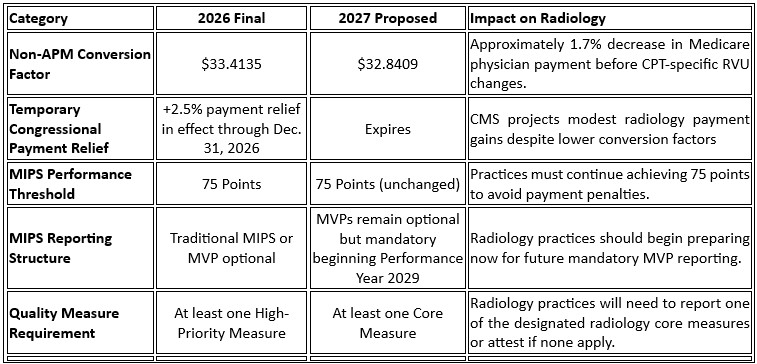
APS Medical Billing continues to advocate for fair valuation of radiology services and will keep our clients informed as CMS finalizes the 2027 rule.
